
Day 40: Understanding IaC and Configuration Management

Hi, I am an AWS-certified cloud engineer and I write about my progress and learnings of DevOps.
Hi everyone!
In the last few days, we deep-dived into AWS and the CI/CD pipeline. Moving on from the public cloud and pipelines, we will be looking into the tools that help us provision infrastructure on cloud and maintain it.
Provisioning infra on the cloud and maintaining it are two completely different practices. However, it could be confusing for many. So to clear the settle the individual use cases today we will look into each of them in detail.
What's the difference?
When it comes to the cloud, Infrastructure as Code (IaC) and Configuration Management (CM) are inseparable. With IaC, a descriptive model is used for infrastructure management. To name a few examples of infrastructure: networks, virtual computers, and load balancers. Using an IaC model always results in the same setting.
Throughout the lifecycle of a product, Configuration Management (CM) ensures that the performance, functional and physical inputs, requirements, design, and operations of that product remain consistent.
Task-01
Read more about IaC and Config. Management Tools
Give differences between both with suitable examples
What are the most common IaC and Config Management Tools?
IaC and Config. Management Tools
Infrastructure as code (IaC) is the ability to provision and support your computing infrastructure using code instead of manual processes and settings. Any application environment requires many infrastructure components like operating systems, database connections, and storage. Developers have to regularly set up, update, and maintain the infrastructure to develop, test, and deploy applications.
What are the benefits of infrastructure as code?
Automation is a key goal across any computing environment. Infrastructure as code (IaC) is used for infrastructure automation to create environments. The most common use of IaC is in software development to build, test, and deploy applications.
Consistency: IaC ensures that your infrastructure is created the same way every time you deploy it, reducing the chances of configuration errors.
Scalability: IaC allows you to easily scale your infrastructure by modifying the code rather than manually replicating resources.
Versioning and Collaboration: IaC code can be versioned, allowing teams to collaborate more effectively and track changes over time.
Disaster Recovery: Recreating your entire infrastructure becomes easier in case of failures or disasters.
What is configuration management?
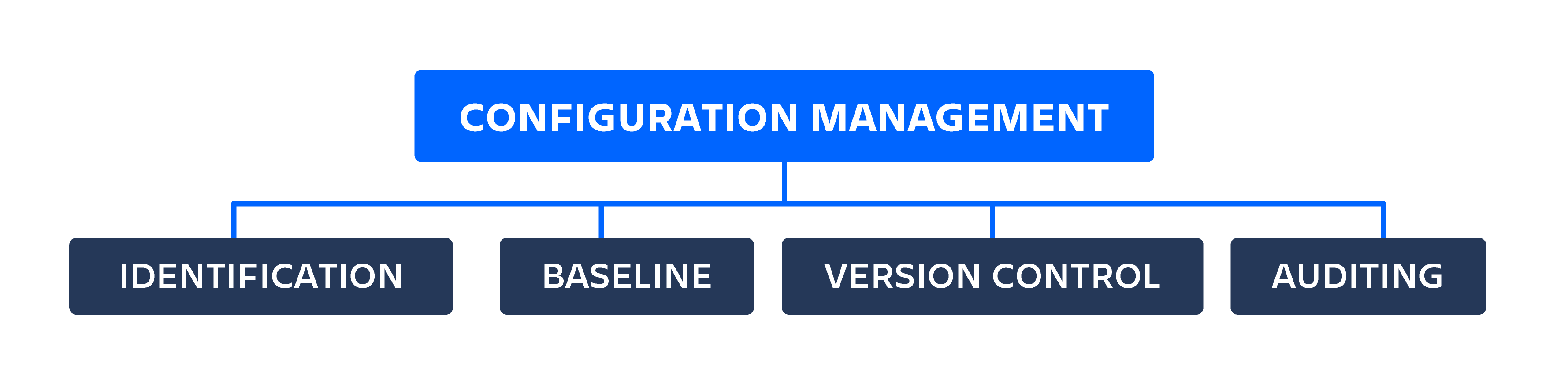
Configuration management is a process for maintaining computer systems, servers, applications, network devices, and other IT components in a desired state. It’s a way to help ensure that a system performs as expected, even after many changes are made over time.
Using configuration management tools, administrators can set up an IT system, such as a server or workstation, then build and maintain other servers and workstations with the same settings. IT teams use configuration assessments and drift analyses to continuously identify systems that have strayed from the desired system state and need to be updated, reconfigured, or patched.
Benefits of Configuration Management:
Consistency: Configuration management tools help maintain consistent configurations across multiple instances, reducing configuration drift.
Automation: Routine tasks like software updates and configurations can be automated, saving time and reducing manual errors.
Compliance: Ensures that systems adhere to security and compliance policies by enforcing standardized configurations.
Rapid Deployment: Automating the deployment of software and configurations speeds up the process and reduces human error.
Infrastructure as Code (IaC) Tools:
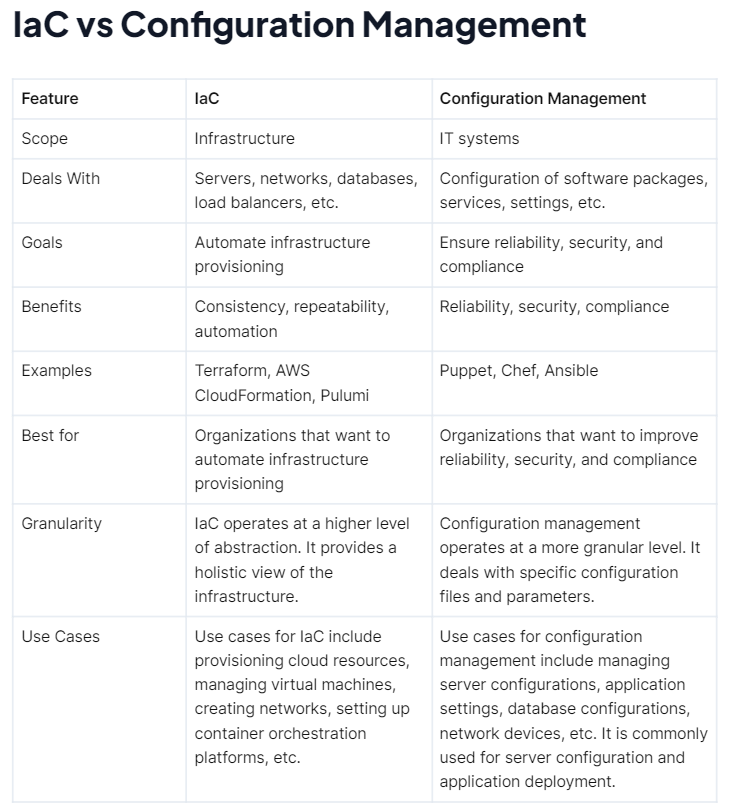
Terraform: Terraform is one of the most widely used IaC tools. It allows you to define and manage infrastructure as code using a declarative configuration language. Terraform supports various cloud providers and on-premises infrastructure, making it highly versatile.
AWS CloudFormation: CloudFormation is specific to Amazon Web Services (AWS) and enables you to create and manage AWS resources using JSON or YAML templates. It’s tightly integrated with AWS services.
Azure Resource Manager (ARM) Templates: Similar to CloudFormation, ARM Templates are used to define and deploy Azure resources in Microsoft Azure cloud environment.
Configuration Management Tools:
Ansible: Ansible is a popular open-source tool that automates configuration management, application deployment, and task automation. It uses a simple YAML-based language and does not require agents on managed machines.
Chef: Chef is a configuration management tool that uses Ruby-based scripts (cookbooks) to define and manage infrastructure. It offers features like recipe and resource definitions.
Puppet: Puppet is another well-known tool that uses its own domain-specific language (Puppet DSL) to define infrastructure configurations. It focuses on enforcing desired state on systems.
Thanks for reading ;)


